



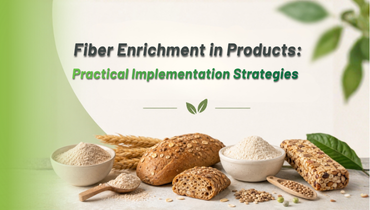
Fiber enrichment addresses one of the most significant nutritional gaps in modern diets. Most consumers fall short of recommended fiber intake—typically 25-30g daily—creating opportunity for food manufacturers to add value through fiber-enhanced products. For R&D teams and production managers, successful fiber enrichment requires understanding which fibers work in specific applications and how to incorporate them without compromising taste or texture.
Why Fiber Enrichment Matters
Consumer health gap – Average fiber intake in developed countries is 15-18g daily, roughly half of recommendations. This deficiency links to digestive issues, cardiovascular disease, and metabolic disorders that consumers increasingly seek to address through food choices.
Market differentiation – Fiber claims stand out on packaging, immediately communicating health benefits. Products can compete on positive attributes rather than simply reduced negatives like sugar or fat.
Regulatory support – Most jurisdictions have clear, achievable thresholds for fiber claims, making this one of the more straightforward health positioning opportunities.
Synergy with trends – Fiber enrichment aligns with gut health awareness, clean eating, and sugar reduction—all major consumer trends that support premium pricing.
Selecting the Right Fiber
Not all fibers work equally well across applications. Selection depends on solubility, taste impact, processing behavior, and functional benefits.
Soluble fibers like sc-FOS, inulin, and resistant dextrins dissolve completely, making them ideal for beverages, dairy, and products where grittiness is unacceptable. They provide prebiotic benefits and contribute to texture without visible fiber particles.
Insoluble fibers like wheat bran, oat fiber, and cellulose work in applications where some texture is acceptable or desired—baked goods, cereals, bars. They provide bulk and support digestive regularity but lack the versatility of soluble options.
Hybrid approach – Many successful products combine soluble and insoluble fibers to maximize both fiber content and functional benefits while managing cost and texture.
For broad application versatility and health positioning, soluble prebiotic fibers offer the best balance of functionality and benefits.
Application-Specific Strategies
Beverages
Fiber-enriched beverages face the challenge of maintaining clarity and pleasant mouthfeel while adding significant fiber.
Solution: Soluble fiber like sc-FOS at 3-6% provides 2.5-4.5g fiber per 250ml serving, achieving “source of fiber” claims. Liquid form integrates directly without dissolution steps. The low viscosity prevents heavy or syrupy texture while contributing body that improves mouthfeel compared to fiber-free reduced-sugar beverages.
Process considerations: Add liquid sc-FOS after base ingredients are combined. Standard mixing is sufficient; high-shear isn’t required. The fiber remains stable through pasteurization and cold storage without precipitation.
Dairy Products
Yogurt, smoothies, and drinkable dairy benefit from fiber enrichment that complements existing health positioning.
Solution: Sc-FOS at 4-8% adds 3-6g fiber per serving while creating synbiotic effects with probiotic cultures in fermented products. The prebiotic fiber feeds beneficial bacteria, enhancing digestive health benefits.
Process considerations: Add fiber before fermentation or post-fermentation depending on product. The fiber doesn’t interfere with culture activity. In fact, it may enhance probiotic survival through the digestive system.
Baked Goods
Bread, muffins, and cookies can accommodate higher fiber levels but require attention to texture and moisture.
Solution: Combine soluble fiber (sc-FOS powder at 3-5%) with insoluble fiber (oat fiber or wheat bran at 2-4%) for maximum fiber content without excessive density. Soluble fiber maintains moisture and extends freshness; insoluble fiber provides bulk.
Process considerations: Sc-FOS powder blends with dry ingredients. Its water-binding capacity requires 5-10% liquid reduction or acceptance of slightly higher moisture that actually improves product freshness. Expect minor density increases; adjust leavening if needed.
Nutritional Bars and Snacks
Limited formulation space makes high-concentration fiber critical for meaningful claims.
Solution: Powder sc-FOS at 95% fiber concentration delivers maximum fiber per gram. Use at 8-12% of formulation to achieve 5-8g fiber per 50g bar, supporting “high fiber” claims.
Process considerations: The fiber contributes some binding properties, potentially reducing need for other binders. Monitor moisture migration in bars with multiple components; fiber’s hygroscopicity can draw moisture from other ingredients.
Cereals
Both hot and cold cereals naturally support fiber enrichment, with consumer expectation of fiber in this category.
Solution: Combine soluble fiber (sc-FOS 3-5%) with grain-based insoluble fiber for total fiber content of 8-12g per serving. The soluble component provides prebiotic benefits while insoluble fiber from grains meets consumer expectations.
Process considerations: For extruded products, validate that fiber withstands extrusion temperatures without degradation. Sc-FOS remains stable through typical cereal processing.
Soups and Sauces
These applications allow fiber enrichment without consumer expectation of fiber, creating differentiation.
Solution: Sc-FOS at 2-4% adds fiber without excessive thickening. The ingredient doesn’t significantly alter flavor profiles or appearance, enabling stealth enrichment.
Process considerations: Add fiber during liquid phase. It remains stable through cooking and retort processing. Provides some viscosity that can reduce need for other thickeners.
Dosage for Claims and Benefits
“Source of fiber” claim – Typically requires 3g per 100g product (or per serving if specified). This is the minimum threshold for fiber messaging in most markets.
“High fiber” claim – Usually requires 6g per 100g product. This higher threshold supports stronger marketing but requires greater formulation effort.
Prebiotic effect – Clinical evidence shows benefits at 2.5-5g prebiotic fiber per serving. Design serving sizes to deliver this amount if prebiotic positioning is desired.
Realistic consumption – Consider how much consumers actually eat. A beverage consumed once daily at 250ml should deliver meaningful fiber (3-5g). A condiment used sparingly might focus on lower thresholds.
Managing Sensory Impact
Fiber enrichment can affect taste, texture, and appearance if not carefully managed.
Taste considerations – Soluble fibers like sc-FOS have mild, slightly sweet taste that doesn’t introduce off-flavors. Insoluble fibers can add earthy or grain notes. Use sensory testing to ensure fiber doesn’t negatively impact flavor profile.
Texture management – Excessive fiber can create density, grittiness, or dryness in baked goods. Balance soluble and insoluble fibers, adjust moisture content, and test at multiple fiber levels to find optimal balance.
Appearance – Insoluble fibers add visible specks. In some products (whole grain bread) this signals healthfulness; in others (beverages) it’s unacceptable. Match fiber type to appearance expectations.
Mouthfeel – Soluble fibers contribute viscosity and body. This is generally positive in beverages and dairy but requires management in products where light texture is expected.
Processing and Stability
Hydration time – Some fibers require time to fully hydrate. Sc-FOS hydrates quickly; longer-chain fibers may need extended mixing or rest periods.
Temperature effects – Most fibers are heat-stable, but validate this for your specific processing conditions. Sc-FOS maintains integrity through baking, pasteurization, and freezing.
pH stability – Soluble fibers remain stable across typical food pH ranges. Extreme acidity with prolonged high-temperature exposure can degrade some fibers; test in your specific formulation.
Moisture migration – In multi-component products (layered bars, filled cookies), fiber’s hygroscopicity can draw moisture from other components. Use moisture barriers or adjust component moisture levels to prevent textural issues.
Shelf life – Fiber’s water-binding capacity can extend freshness in baked goods by preventing staling. However, it can also support microbial growth if water activity isn’t properly controlled. Validate stability throughout intended shelf life.
Cost-Benefit Analysis
Fiber enrichment involves ingredient costs but creates value justifying premium pricing.
Ingredient costs – Soluble prebiotic fibers cost more than basic bulking fibers. However, their functional benefits (sweetness, prebiotic effects, processing stability) deliver value beyond simple fiber content.
Yield improvements – In some applications, fiber’s water-binding capacity can increase yield, offsetting ingredient costs.
Premium positioning – Fiber claims support 10-20% price premiums in many categories, particularly when combined with other health benefits like sugar reduction.
Reduced reformulation – Using multifunctional fibers like sc-FOS that contribute sweetness and texture reduces need for multiple specialized ingredients.
Label and Marketing
Claim language – Use the strongest claim your product supports. “High fiber” is more compelling than “source of fiber” when achievable. Combine with other claims (“high fiber, reduced sugar”) for maximum impact.
Communication clarity – Many consumers don’t understand fiber’s benefits beyond digestive health. Simple messaging about gut health, sustained energy, and feeling full resonates broadly.
Prebiotic positioning – Where permitted, prebiotic messaging differentiates from generic fiber products. It signals advanced nutritional thinking and aligns with gut health trends.
Front-of-pack – Fiber content should be prominently displayed. Grams per serving are more meaningful to consumers than percentages of daily value.
Implementation Roadmap
Start with optimal applications – Begin fiber enrichment in products where it’s easiest: beverages and dairy for soluble fiber, baked goods and bars for combined approaches. Build expertise before tackling challenging applications.
Bench test thoroughly – Test multiple fiber levels to find the maximum that maintains quality. Often this is higher than initially expected when using well-selected fibers.
Scale validation – Pilot production confirms bench results translate to commercial scale. Processing times, mixing speeds, and equipment limitations may require formula adjustments.
Consumer testing – Validate acceptance before full launch. Test not just liking but purchase intent—consumers must actually buy the enriched product.
Iterative improvement – First versions may not be optimal. Collect feedback, refine formulations, and continuously improve based on consumer and production insights.
Fiber enrichment transforms products from nutritionally adequate to nutritionally superior. Soluble prebiotic fibers like sc-FOS provide the versatility, functional benefits, and health positioning to make enrichment practical across diverse applications. The key is selecting appropriate fibers for each application, managing sensory impact through careful formulation, and positioning the health benefits clearly to consumers who increasingly seek fiber in their diets